
Der letzte Schrei
What does a disappearing glacier sound like?
Since 1960, Austrian glaciers have been measured year by year. Their retreat is documented in meters — precise, scientific, accumulating. Taken together, the 79 measured glaciers withdrew an average of 20.3 meters in 2025 alone. But numbers alone do not make loss perceptible. They remain in spreadsheets, in reports, in archives.
Der letzte Schrei translates six decades of glacier data into something that can be heard — and seen.
The project consists of two sonic translations.
Underlying both translations: annual length measurements from the Austrian Alpine Club's glacier monitoring service and HISTALP temperature records, processed and modeled in R.
For Bergauf, the member magazine of the Austrian Alpine Club, this became a two-page print data story. The scale of loss rendered concrete: the ice one glacier lost in a single year, shaped into a cube, would swallow Vienna's Stephansdom whole. Only the south tower would still reach above the surface.
Let us listen — before it goes quiet.
For Bergauf — the member magazine of the Austrian Alpine Club — the project took the form of a two-page print data story. Glacier length measurements and Alpine temperature anomalies were translated into a visual narrative spanning six decades: a timeline of retreat, punctuated by a portrait of Rosa, a fictional woman who grew up when glaciers still grew, and her granddaughter Anna, who has only ever known them shrinking. The scale of loss is made concrete through comparison: the ice the Seekarlesferner lost between 2024 and 2025 alone, shaped into a cube, would swallow Vienna's Stephansdom whole — only the south tower would still reach above the surface.
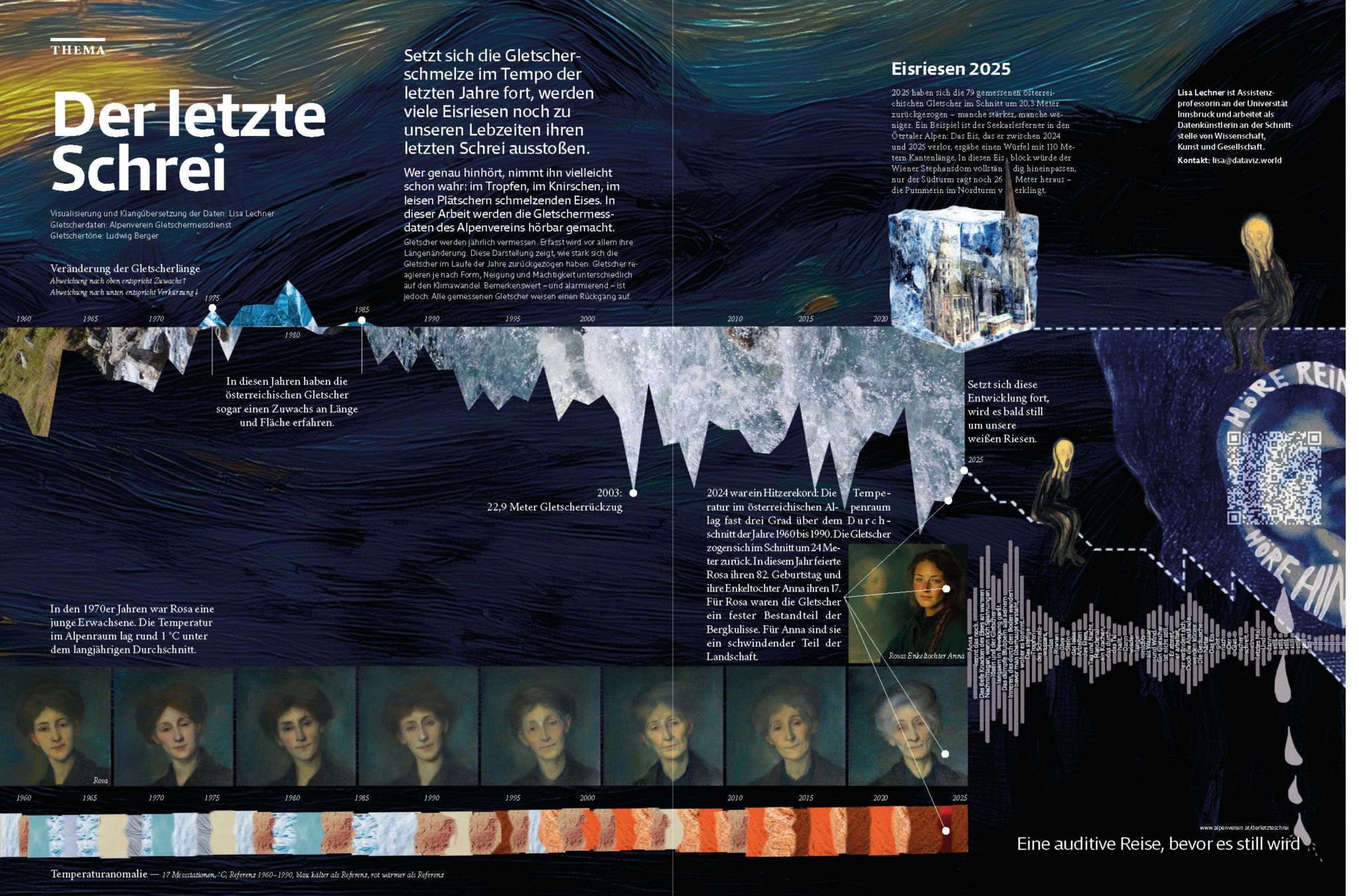
The first spans 1960 to 2025. It layers two data streams: glacier tone and temperature tone. The glacier tone reflects the mean annual length change of Austrian glaciers — drawn from field recordings by Ludwig Berger, captured with underwater microphones inside glacial crevasses and meltwater channels, and mixed into a composition where the intensity of melt becomes the intensity of sound. The stronger the retreat, the more present the water. The temperature tone follows the mean annual anomaly across 17 HISTALP stations: the warmer the year relative to the 1961–1990 reference period, the higher the pitch. These tones were synthetically composed. Color reinforces the temperature signal as texture — from ice blue in cold years to deep red in the warmest ones.
The second translation looks forward. Based on the retreat rates of the last ten years, the trajectories of three glaciers were projected into the future — toward the moment each one falls silent. The Alpeiner Ferner in the Stubai Alps, still around 2,500 meters long but retreating by nearly 60 meters per year. The Wildgerloskees in the Zillertal Alps, 1,300 meters long, moving more slowly. And the Gößnitzkees in the Schobergruppe — barely 500 meters, partially shielded by debris — likely the last to go, but going nonetheless. Three glaciers. Three very different stories. Three projected silences.